

The journalists fighting for women’s rights by keyboard, camera and airwaves
By Alexandria McCarthy
World Press Freedom Day on 3rd May celebrates journalists’ rights to safety and independence as they do work that contributes to human rights, justice and sustainable peace.
This year’s World Press Freedom Award goes to Khadija Ismayilova, an investigative journalist from Azerbaijan who, in investigating the Azerbaijani presidency’s corruption, embezzlement and illegal business dealings, was herself levelled with those very charges. It is hard to appreciate the court’s ironic bent when a courageous human rights defender who stood fast against a crooked regime’s repressive threats is imprisoned for 7.5 years under what human rights groups agree are trumped-up charges.
While we celebrate Khadija’s dedication, it is worth remembering that she stands for a much larger body of women who fight for women’s rights by keyboard, camera or airwaves. In countries where freedom of the press is not guaranteed and journalists risk being silenced by state authorities and civilians alike, their dissent becomes more important than ever to shine a spotlight on the invisible and give a megaphone to the voiceless. As journalists, they may face threats of physical and psychological violence from those powerful people they scrutinise; as women, they face an additional layer of gendered violence, from online abuse to sexual violence.
A man’s world
Journalism is still in many countries a male-dominated field that does not always account for women’s daily lived experiences; when women’s perspectives are portrayed, they aren’t necessarily covered in gender-sensitive ways or don’t detail women’s differential experiences. In a recent interview with Women Under Siege, freelance journalist Amanda Sperber recalled a response from an editor on her story pitch on rape in South Sudan: “Yeah, people are raping each other in South Sudan. There’s no news hook.” Without women journalists like Amanda to notice and to fight for them, certain stories may never get told, women’s points of view would stay hidden, and gendered stereotypes like victim-blaming are more likely to be perpetuated.
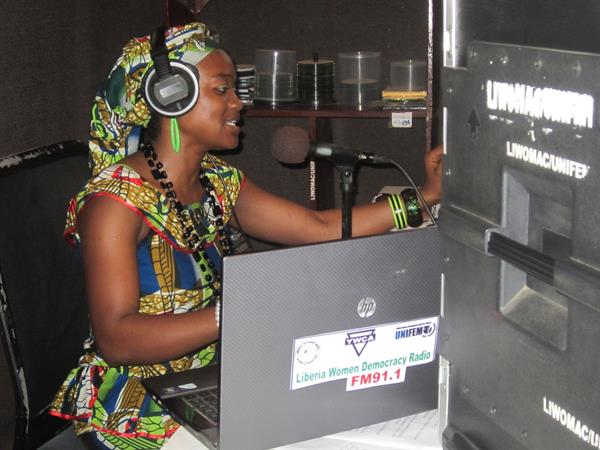
With this systemic exclusion of women, sometimes just breaking into the business can be an act of defiance. Womankind’s partner Liberia Women Media Action Committee (LIWOMAC) hosts the first radio station for women in Liberia and does important work to train journalists to (1) cover women’s rights issues and (2) in a gender-sensitive way that (3) caters to women’s specific experiences. Its game-changing mission has helped to increase the number of women journalists in the Liberian media from 13% in 2010 to 22% in 2014, directly challenging women and men’s beliefs that women have no place in journalism. By training both women and men to cover women’s legal rights, inheritance laws, and educating women and girls about rape and forced marriage, they are empowered to unearth stories that had not been previously covered, despite risking patriarchal retaliation.
Silencing women journalists
In 2013, the International Women’s Media Foundation found that 64% of women journalists around the world have experienced intimidation, threats or abuse via work, and nearly half have experienced sexual harassment. An analysis by The Guardian earlier this year found that, of 1.4 million comments blocked on its threads, the highest levels of abuse and dismissive trolling were targeted toward articles written by women, regardless of the article’s topic. And is anyone surprised that articles about feminism and rape attracted the highest levels of blocked comments? Silencing women journalists is to deny them their freedom of speech and their basic human rights.
The Reporters Without Borders’ 2016 World Press Freedom Index showed a “deep and disturbing decline” in media freedom thanks to authoritarianism, state control and repression. Last year, Iranian cartoonist Atena Farghadani uploaded a post to Facebook, mocking the Iranian parliament for restricting access to contraception. This landed her in prison, and shaking hands with her male lawyer led to them both being charged and tried behind closed doors for “illegitimate sexual relations short of adultery.” Sexualised violence in reprisal is common; in Khadija’s case, after refusing to stop her corruption investigations, she received anonymous sex photos of herself being surveilled in her own home.
This World Press Freedom Day we must commit to supporting a free, independent and diverse press as well as the journalists who uphold our society’s values. Khadija said during her final statement in court that “I might be in prison, but the work will continue.” For all our sakes, the work must continue.


