


The Commission on the Status of Women (CSW69) was held in New York in March 2025 against the backdrop of the 30th anniversary of the Beijing Declaration and Platform for Action (BDPfA). CSW69 revealed that whilst there has been progress, there is still a long way to go in achieving gender equality. Women’s human rights remain under constant threat from conservative, populist, and fundamentalist forces. This underscores why women’s rights organisations must safeguard hard-won gains in key advocacy spaces, as anti-rights and anti-gender movements continue to undermine progress and shrink civic space worldwide.
Established in 1946, CSW remains the main intergovernmental body exclusively dedicated to promoting gender equality. Each convening focuses on a priority theme and evaluates the progress of a review theme from a previous year. Womankind actively participates in CSW by engaging in advocacy, co-hosting events with partners, and contributing to policy dialogues that reflect the priorities and voices of feminist movements.
For CSW69, Womankind published a BDPfA+30 Review Report (researched and written by Mari-Claire Price and Raisa Phillips) inspired by the knowledge and lived experiences of our partners civil society organisations, feminists, and women’s rights advocates including partners. The report reinforced the positioning of Womankind and partners as agents of transformative change in relation to the realisation of the BDPfA, viewed through a bold and progressive intersectional feminist lens, and drawing on insights that informed key discussions, position statements, and recommendations provided by Womankind partners and allies.
Womankind also supported partners under AWESOME (Ethiopian Women with Disability National Association (EWDNA), Siiqqee Women’s Development Association (SWDA), Federation of Women Lawyers (FIDA Kenya), Women Challenged to Challenge (WCC), and Forum for Women in Democracy (FOWODE)) to attend, collectively strategise, and form linkages. AWESOME partners co-created a high-level roundtable event for CSW69 and collaborated with regional feminist organisation FAWE – an organisation that works on women’s participation and leadership as it intersects with the right to education for women and girls in all their diversities.
The collaboration with FAWE expanded the scope of learning and sharing and also enabled a cross sectoral exchange expanding the discourse beyond AWESOME focus countries and including insights from 31 African countries. The session provided a platform to present feminist futures where women and girls enjoy equal opportunities and parity in leadership and participation in decision making. This strategically positioned AWESOME Consortium members as credible actors influencing global gender equality efforts through feminist leadership and advocacy. The parallel event also provided an opportunity for AWESOME Consortium members to amplify their work to a global feminist and human rights audience and facilitated a conducive environment for future partnerships including with funders/donors.
Womankind also co-planned other side events with partners, African Women’s Development and Communications Network (FEMNET), Forum for Women in Democracy (FOWODE), Polycom Girls and Deaf Women Included (DWI) and with Equal Measures 2030. The Womankind delegation participated in a wide range of events that reflected both leadership and cross-movement collaboration and our partners played a central role in twelve events.
Through the Women’s Rights Caucus and UK NGO/CSW, contributed to the CSW69 Agreed conclusions and CSW69 Outcome Document ensuring that it represented the voice and priorities of women and girls. Womankind also contributed to the UK group of organisations, informing the collective response to the UK to inform the Zero Draft and subsequent drafts. Colleagues engaged with UK representatives on the ground at UK side events. We spoke at the Foreign, Commonwealth and Development Office (FCDO) on the global backlash to gender equality at a pre-CSW event, drawing in examples from our partners’ work. We highlighted our key messages and concerns, which UK government representatives were noting to inform the delegation’s engagement in CSW, including:
- The importance of the UK using its influence on the world stage to stand up for the rights of women and other marginalised groups – including to reproductive healthcare and bodily autonomy – and raise concerns about regressive international policies like the Global Gag Rule.
- Advocating for the inclusion of Afghan women (and all women)’s voices in decision-making and standing against the gender apartheid they’re facing.
- Targeting Official Development Assistance (ODA) funds specifically for gender equality – making sure the money reaches women’s rights organisations and feminist movements through flexible funding and recognising their expertise.
This was the first time that language on gender-based violence was included, together with language on harmful practices. By leveraging social media, Womankind engaged and mobilised stakeholders through tools such as the B+30 factsheet, Instagram reels and lives, and infographics. These efforts effectively conveyed key advocacy messages and drove accountability for Beijing+30.
The Association for Women’s Rights in Development (AWID) Forum is a flagship global gathering. It brings together over 3,500 feminist and gender justice advocates, activists, scholars, funders, and policymakers. 13 Womankind staff attended, and we supported 12 partners and 4 informal group participants to join the December 2024 forum in Thailand. The Womankind team facilitated pre, during, and post-event coordination and provided strategic communications and advocacy support. We used the space to facilitate learning and exchange, deepen solidarity, influence global narratives and funding practices, and ensure the inclusion of marginalised voices.
Womankind co-convened two impactful side events, together with partners, creating space for dialogue, advocacy and collaboration with feminist movements and partners.
In our first event, Womankind supported cross-movement pollination and the enrichment of the corporate justice movement through our event, ‘Women’s Economic Rights (WER): Feminists for a Binding Treaty’ This session was co-led by Womankind alongside Feminists for a Binding Treaty collective (F4BT). The session aimed to demystify the UN Binding Treaty (UNBT) process and connect corporate justice work with the day-to-day activism of attendees. With over 50 organisations in attendance, including diverse feminist collectives and UN bodies, the event contributed to growing the movement by welcoming 30 new organisational sign-ups and incorporating previously under-represented perspectives (including LBTQI+ women) to corporate injustice. These perspectives were integrated into the collective advocacy for a treaty to end corporate abuse, helping to broaden and deepen the movement.
Our advocacy went beyond the event. Womankind continued to engage in feeding in the views collected from partners and other groups during the session and our follow up engagements. We did this both in the statements we contributed to as part of F4BT for the most recent UN session and intersessional meetings. We also continued our advocacy on corporate justice with the UK government, including the Corporate Justice Coalition Gender Briefing, which we co-developed. Here we shared and reflected our partners’ perspectives in our influencing with the UK government and UN.
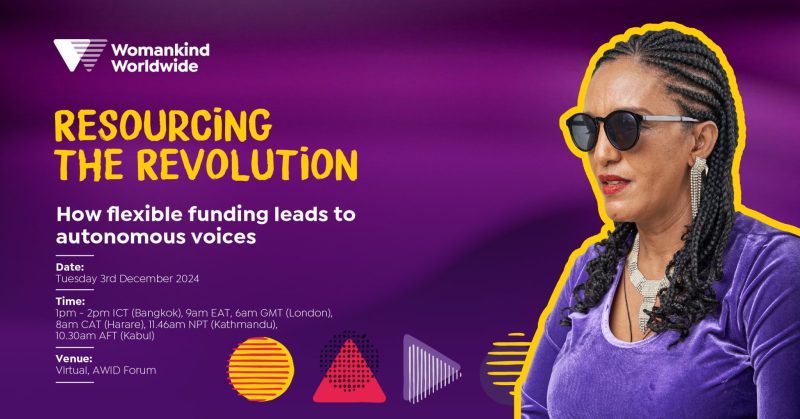
The second event, ‘Resourcing the Revolution: How Flexible Funding Leads to Autonomous Voices’, centred on the critical role of flexible funding in advancing feminist organising. We spotlighted Womankind’s three flexible funds. The event served as a platform to advocate for the transformative power of flexible funding in resourcing feminist movements. We demonstrated how feminist funding approaches rooted in care, trust, and solidarity can foster deeper relationships with sector allies and partners. The event enhanced the visibility of both Womankind and partners, affirming the legitimacy of decolonised feminist organising that elevates and centres the voices and leadership of grassroots actors. Partners used this platform to engage in donor advocacy around resourcing feminist movements. These efforts were reinforced by the dissemination of a learning brief, helping to inform and influence wider sector dialogue.


