

Maggie Baxter awarded CBE for services to gender equality and as Chair of Womankind Worldwide: a message from Maggie
By Maggie Baxter
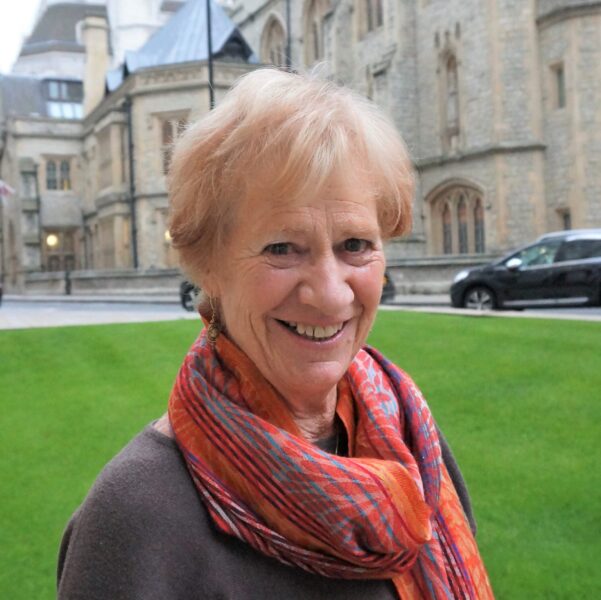
It is a true honour to be recognised in this year’s Queen’s Birthday Honours List and encouraging to see the issue of women’s rights acknowledged on this national platform. This year has presented huge challenges for women’s rights as well as for people impacted by the harsh realities of the coronavirus pandemic and climate change. The pandemic has put into sharp focus inequalities experienced by so many; inequalities in health, income, ethnicity and gender.
I have worked in women’s rights, international development and the voluntary sector for over 45 years and during that time I have worked alongside women’s rights activists around the world, and in the UK, and witness the great progress achieved together. Globally, the number of seats in national parliaments held by women has more than doubled in the past 25 years. In the last decade, 131 countries have adopted laws in support of gender equality.
At Womankind Worldwide, where I served as Executive Director from 1999-2007 and now Chair of the Board since 2017, we work with women’s movements to create change for women and girls. Together with our partners we have helped women get elected, supported women to assert their economic rights and independence, contributed to ending violence against women and girls, and lobbied for changes in the laws and policies that oppress women. Since Womankind was founded in 1989, our partners have transformed the lives of women and girls across the globe. Just a handful of
these achievements include:
- Creating safe spaces for women and girls: From raising funds to create a safe house for street girls in Brazil in 1991 to our ongoing support of the first women’s-only shelters for survivors of violence in Ethiopia, together with our partners we have enabled over 13,000 women and girls to seek refuge from violence.
- Increasing women’s representation in politics: From 2012 to 2015, Dalit women’s political party membership in Nepal increased from 299 to 2,112. In Ghana, while just over 4,600 women stood for local committee election in 2010, this number rose to 12,000 in 2015. Meanwhile in Kenya, our support contributed to a 121% increase in the number of women standing for 2013 elections.
- Working towards the end of female genital mutilation (FGM) and early and forced marriage: Recognising both FGM and child marriage as forms of gender-based violence, we’ve remained steadfast in our efforts to see their demise. In 2000, we supported one Kenyan partner to provide 90% of FGM practitioners in one region with alternative skills training.
- Advocating for an end to domestic violence: After years of lobbying, Womankind and partners helped secure the introduction of domestic violence legislation in Albania, Ghana and Zimbabwe, cementing women’s rights to live free from violence in national policy.
These successes would not have been possible without the drive and determination of women’s rights organisations, activists and movements delivering change at all levels. Any honour I receive is on behalf of all the women that I have worked with throughout my career.
I strongly believe that with the great privilege of being awarded this honour comes great responsibility. I recognise my privilege, as a white woman living in the Global North, and I want to use this opportunity to amplify the voices of women across the globe who have not had the same opportunities as me and who continue to experience significant marginalisation and discrimination.
In recent years, the Queens Birthday Honours list has recognised the achievements of an increasingly diverse set of individuals leading change and representing excellence in their field. I therefore support the call made by charity leaders earlier this year in replacing the word ‘Empire’ with ‘excellence’ as this would mark a break in the UK’s colonial past and more accurately reflect the values the Honours system now reflects.
I am deeply grateful for the honour and the opportunity to pass on the recognition to our partners in realising women’s rights across the world. This is especially pertinent in 2020. Despite progress made, there still isn’t a single country in the world that has achieved gender equality and the COVID-19 crisis has further deepened existing inequalities. From increased domestic violence, to their roles as health workers, to their roles as unpaid carers in the home, to the decimation of their small businesses and livelihoods, women are being disproportionately impacted by the pandemic and the most marginalised are being hit hardest. As need for our partners’ services has increased during the crisis, Womankind partners have stepped up to counter the impacts of COVID-19 in their communities. But the pandemic has taught us that the status quo doesn’t work. This is an opportunity to work towards a new transformational system that guarantees human rights for all. As things get harder, we must speak louder. Being recognised for this great honour emboldens our cause. We won’t stop until the rights of women in all their diversity are respected, valued and realised.


