

Women are standing #withrefugees in Tanzania
By Estelle Bloom
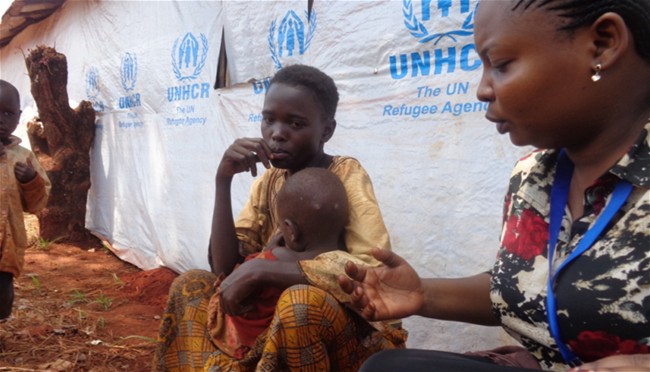
“I didn’t know what to do. But WLAC gave me legal advice and told me how to report this violence.” – Aline, Tanzania.
On World Refugee Day, we take a look at the work of our Tanzanian partner, the Women’s Legal Aid Centre (WLAC), who provides a lifeline to highly vulnerable women and girls in the Nyarugusu refugee camp
The global refugee crisis has caused huge suffering to millions of women and girls worldwide, not least because of the extra dangers they face simply because they are women. These include rape, assault, exploitation, trafficking, forced marriage and not being able to access such simple things as water, food and legal support.
Around the world people are fleeing oppression, war and discrimination. The current situation in Europe is like nothing we’ve seen since the Second World War. But the situation is truly global and many places have had huge refugee camps for many years. Tanzania is one such place. And over the last year the number of people fleeing there is reflecting global trends: it just keeps getting higher.
Over 250,000 people have fled Burundi in the last year, which is a huge increase on previous years. Last April the Burundian President Pierre Nkurunziza announced he would run for a third term. The campaign of violence and intimidation that followed forced many to leave their homes in fear of their lives. Many have ended up at the Nyarugusu refugee camp in Tanzania. With over 140,000 inhabitants, it is one of the largest and most overcrowded camps in the world. Over two thirds of people in the camp are women and girls, many of whom have experienced terrible abuses even before they arrived.
Riddled with dangers
The sudden influx has left Nyarugusu overcrowded with health, education and other critical services massively overstretched. Conditions in the camp are dire with thousands of new arrivals, mainly women and children, being forced to live in mass shelters where in the rainy season wet floors and cramped conditions mean that the risk of respiratory infections and waterborne diseases is high. An outbreak of cholera last June claimed 35 lives.
And for women and girls specifically, the Nyarugusu camp is riddled with dangers, such as sexual violence, forced marriage and child labour. In just a few months there were 224 reported cases of violence in or around the camp, including rape and sexual assault. And that’s just the tip of the iceberg, the unreported cases are assumed to be much higher.
Women and girls report feeling unsafe in most areas of the camp, including showers, toilets and their own homes. The most dangerous area, however, is the camp perimeter, where many go to collect firewood. The International Rescue Committee claims around two to three women a week are raped here.
“Every day, millions of women and girls travel up to 20km into unsafe areas to collect firewood, where they are exposed to physical and sexual violence. Firewood collection is often cited as the most dangerous activity that they must undertake in their daily lives.“ – Women’s Refugee Commission, 2014.
Rebuilding lives
In this terrifying context, our partner the Women’s Legal Aid Centre (WLAC) has stepped in to keep women and girls safe and and help them rebuild their lives after their hugely traumatic experiences and journeys.
Aline, 24, from Burundi, is one such woman. She told us,
“l live in zone 8 of the camp. I have been facing threats when at home and fetching firewood. One night when I was at home with my children a man came in and tried to rape me. Luckily my neighbours were passing by and rescued me. I didn’t know what to do. But WLAC gave me legal advice and told me how to report this violence. WLAC will keep visiting me to check on my progress.”
So far WLAC has supported thousands of women survivors of violence to access justice through legal aid and support. They’ve also trained 78 refugees to be paralegals so they can offer free legal advice and
WLAC is also spreading awareness in the camp of what women go through and the laws that protect them. They’ve held sessions with refugees, police, government officers and camp leaders on things like female genital mutilation, violence and forced marriage. They have big campaigns in the camp, reaching over 40,000 people with posters, leaflets and events in places like churches, reception centres and medical tents.
Before WLAC’s intervention, it was very difficult for women and girls to seek justice for abuses against them. Now WLAC is taking a holistic approach to ensure Nyarugusu is a place of refuge, not danger, for the thousands of vulnerable women and girls who arrive there.
If you would like to support other women like Aline please give a gift today.


