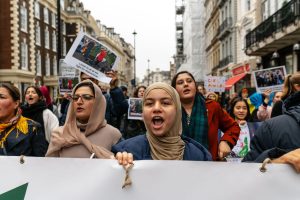

“Afghan women and girls remain unstoppable”
Organisation X* works to advance women’s rights, leadership, advocacy, economic empowerment and protection, while strengthening the capacity and sustainability of women-led organisations, through activities such as training, network-building and institutional development.
Shamshad* serves as Deputy Director of Organisation X and has witnessed the Taliban’s attempts to erase Afghan women from society since 2021. He describes how the situation has rapidly deteriorated, shattering decades of progress in women’s and girls’ rights.
“Women and girls have been excluded from education, employment, public life and decision-making. Restrictions have affected nearly every aspect of their lives, while women-led organisations continue to operate amid heavy surveillance and resistance from the Taliban,” he says.
A closed civic space
But despite these challenges, Afghan women and girls continue to demonstrate extraordinary resilience and resistance.
To adapt to current realities and ensure their work remains effective, Organisation X has shifted its approach from traditional development programming toward protecting closing civic space, sustaining women-led organisations, strengthening feminist solidarity, and protecting women human rights defenders. This has included expanding efforts to strengthen women’s resilience, secure their livelihoods, provide digital and physical security training, and promote local leadership so that women remain connected.
Shamsad reflects on what gender apartheid means and describes how this is a daily reality in Afghanistan through the systemic discrimination of women and girls. “We wake up to new restrictions designed to exclude women from public life and every sphere of decision-making,” he adds.
In the last five years, funding for women’s rights has become increasingly limited, short-term and project-based. While humanitarian funding has been mobilised during crises such as earthquakes and floods, Shamsad notes this remains insignificant given the scale of work needed.
“Flexible institutional funding and long-term investment in women’s rights organisations have declined significantly. Our organisation, now has to compete for fewer resources while responding to growing needs and increasingly complex operating conditions,” he says.
Flexible and long-term funding focused on local agency and expertise
Funding gaps have forced Organisation X to scale back institutional capacity, staff development, movement-building, coordination and long-term advocacy. “Our message to donors is clear: invest directly in the survival and sustainability of local women-led organisations through trusted national women-led networks, which are best positioned to ensure resources reach vulnerable women and girls across Afghanistan,” he says.
Flexible, predictable and long-term institutional funding is as critical as project funding, since strong local organisations are the foundation of a resilient and sustainable women’s movement.
A call to the international community
Five years on, genuine solidarity from the international community is needed now more than ever — through trust-based partnerships, flexible funding, centring local priorities, sharing decision-making, and standing with Afghan women.
“What has fallen short are short-term projects, highly restrictive funding requirements, and consultations that do not translate into meaningful action. Long-term engagement means sustained investment in Afghan women’s leadership, institutional strengthening, movement infrastructure, and meaningful participation in international decision-making,” says Shamsad.
Afghan women’s local and international advocacy remains powerful — from resistance campaigns both online and offline, they have been bold in defending their autonomy and demanding urgent action. But while this is a welcome shift, Shamsad urges holistic inclusion on global platforms, where women are not merely included but given real opportunity to influence decisions.
“Afghan women living and working inside the country must be meaningfully represented in international forums, as they have firsthand experience of the realities on the ground. While diaspora perspectives are important, decisions about Afghanistan should be informed by those directly affected, and made with the equal participation of Afghan women,” he adds.
And there is hope. Shamsad says his hope comes from the courage, resilience and unwavering determination of Afghan women and girls, who continue to learn, lead, organise and support one another despite immense challenges.
“Every woman who continues advocating for her community, every girl’s learning initiative, every women-led organisation that remains operational, and every act of solidarity strengthens our belief that lasting change is still possible. Organisation X remains committed to ensuring that Afghan women’s voices are not silenced, and that their rights remain at the centre of Afghanistan’s future,” he says.
*Real names witheld to protect identity
< View all stories