

Survivors of forced sterilisation get justice in Peru
1 February 2016
By Hannah Coombes
By Hannah Coombes
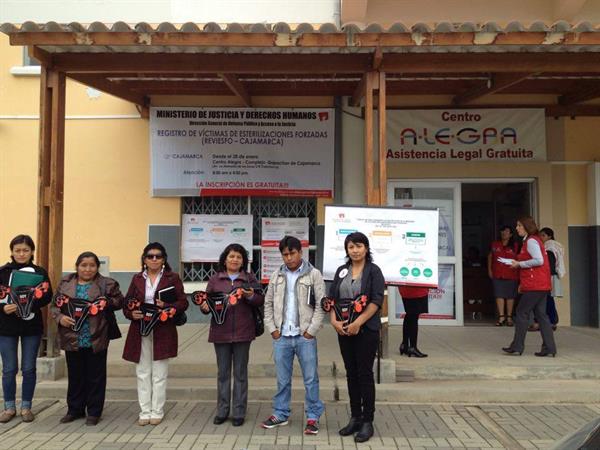
Pictured: DEMUS staff with Mamerita’s son last week outside the first registration of forced sterilisation survivors
Last week, the Peruvian government started the process of formally registering survivors of forced sterilisations, finally bringing justice for thousands of women.
In the late 1990s, the Peruvian government sanctioned a surgical sterilisation scheme known as ‘voluntary surgical contraception’ as part of a poverty reduction campaign. Between 1995 and 2000, over 300,000 women were sterilised, most of them poor, illiterate and indigenous. In a bid to reach high targets, many women were forced into sterilisation and were threatened or denied essential medication and food. Some were sterilised without their knowledge or consent, after childbirth or at routine pregnancy check-ups. Until now, the government hasn’t formally recognised the abuse inflicted by the scheme.
Justice for Mamerita, who died aged 33
Symbolically, the registration process started in Cajamarca last Thursday, the home of Mamerita Mestanza, whose test case was brought against the State by Womankind Worldwide’s partner, DEMUS, whom we have supported since 1999, alongside two other organisations. This proved to be a landmark case and played a pivotal role in the Peruvian government recognising the issue of forced sterilisations and ultimately starting a registry to bring about justice for thousands of women.
At the age of 33, Mamerita, a mother of 7, died from complications after being forcibly sterilised. DEMUS (the Institute for the Defence of Women’s Rights) filed a case against the Peruvian State with the InterAmerican Court on Human Rights in 1999. Four years later, the State brought to justice the perpetrators and agreed to provide reparations to Mamerita’s family. This paved the way for 2,074 women to come forward and seek justice for their own forced sterilisations.
DEMUS defends women’s rights in Peru
DEMUS didn’t stop there; with our support, the women’s rights organisation has been working for 15 years for justice for these women. Most recently, in October 2015, it launched a campaign called Somos 2074 y muchas más (we are 2074 and many more), which aimed to mobilise Peruvians and push for a public reparations policy for victims.
The new registry aimed at identifying survivors of forced sterilisation is an overwhelming victory for DEMUS, but the hard work has only just begun. While the registration process will mean that women will have access to justice and services, there are still thousands of women who haven’t come forward as survivors of forced sterilisation and there are questions over how the Peruvian government will provide sufficient support.
Striving for justice for all women abused by the scheme
Womankind is supporting DEMUS in its ongoing work on this issue, and would like to congratulate everyone involved in reaching this significant women’s rights milestone in Peru. With your support, DEMUS will continue applying pressure on the government to ensure that survivors get the justice and reparations they deserve.
To support our partners in Peru, please give today.


