
“We create our own families, freedom, peace, and healing”
Mary Audry Chard lives in Harare, Zimbabwe and is in her 10th year as Director of Rise Above Women’s Organisation (RAWO). She advocates for the rights and freedoms of lesbian, bisexual, and queer identifying women, and is a long-term member of Pakasipiti‘s community.
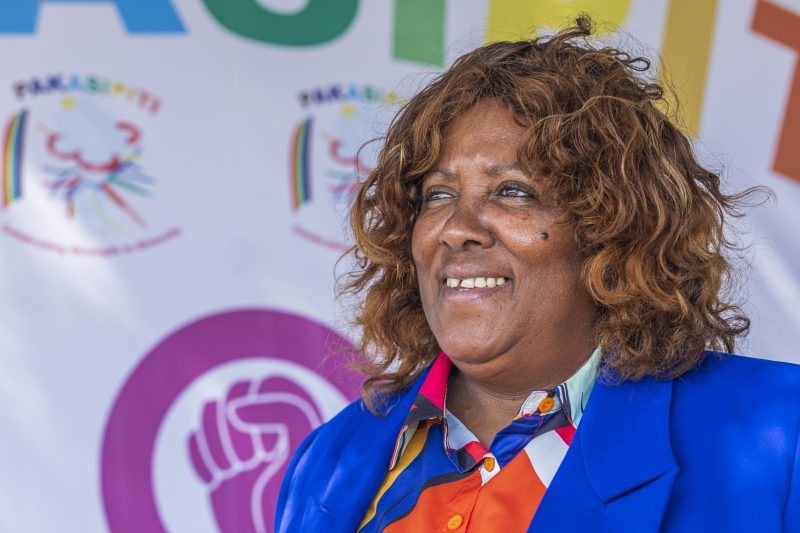
“My work in women’s rights started in 1998 in Amsterdam, when I went to the Gay Games. It was the first time I felt I could walk in the street with my girlfriend. That was the catalyst for me saying, ‘why can’t this be okay?’ When I came back, I knew I couldn’t work in the private sector anymore, though it took me until 2014. In the meantime, I worked within the movement, seeing more and more that this was the work I wanted to do, until we formed RAWO.
RAWO’s work now is mainly access to health for women: we’re collecting data at 12 facilities across the country, assessing why LBQ women aren’t accessing healthcare.”
The ripple effect of Pakasipiti’s work
“Initially I was just a member of Pakasipiti’s community, until I saw what was going on and thought, we can form something else as well.
In many meetings where Pakasipiti advocated for queer women’s rights, they were sidelined. Patience, the Director, got the brunt of it because she was the one who opened the doors, but those paths were paved, so that we were then able to sit and have the discussion.
At some point I felt Patience couldn’t be the only voice. Even outside of Pakasipiti, I could do something too. That’s how RAWO started.
Pakasipiti showed us the way. We advocated for each other outside of any structures, not as colleagues but as friends, as sisters, all navigating that world of being queer.
We almost lived in silos. But slowly, Pakasipiti created spaces where your realities mattered. You could talk about things, I didn’t eat yesterday, I’m kicked out of my house, and they’d be held in confidence. Help was offered, even if it was just a hug. It was something everybody wanted, and the community keeps growing.
This house…there’s a sense of peace I have when I come here. I can be unwell and vulnerable, go into a room and just lie down, shut the world out. It’s almost like a refuge.
Womankind’s partnership with Pakasipiti has supported them to be here and to support us. As Mary, an older person, the director of a queer organisation, I’m taken care of in different ways. But they can only do that because they’re okay; you can’t help somebody if you’re not okay. I am one, and there are hundreds of women behind me.”
The current context for working on LBTQI+ rights 
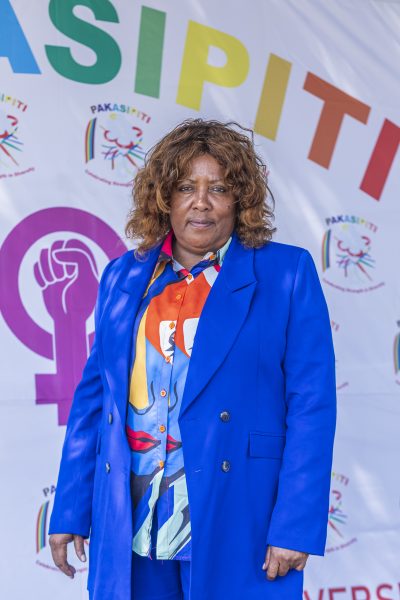
“A lot of the time we’re not able to do the work the way we want to. There are two big factors: the safety of the work, and funding for an organisation’s core activities. We can go six months to a year without funding of any kind, but you’d still expect the work to be done. Young people coming in, some straight out of university, some still living at home, can’t always explain this commitment to their families when there’s no money coming in. And even when we’re paid, core administrative funding is tiny compared to the grant. My aim is to let young people lead.
We’re also facing more dangerous street justice. It used to be that you’d be harassed, spat at, maybe taken to a police station. Now it’s extremely violent, you can die at the scene, for wearing a short skirt on public transport. And it’s not random people, it’s the ones who control the transport and the bus stops, the rank marshals, the drivers, the combi loaders. It’s their territory. You’ve just got to be so careful.”
This reality shows how crucial safe spaces for LBQ women are. For Mary Audry, these spaces are “support and family. We create our own families, freedom, peace, and healing. And we heal in different ways. Sometimes my healing comes from going into a room and sleeping. Sometimes it’s meeting a group of older queer women, and I can laugh the whole afternoon and just be in a space I’m happy in.”
Hopes for the future of the movement
“Activism is a long game. Things are happening now that we started working on 10 years ago. I’d like the community to know us beyond our programming. I really want us to create more than one safe space, and to sustain them.
I hope to see a young women’s organisation establish itself. How do we go from having a wellness centre to having a safe house? How do we protect the human rights defenders on the front lines? It’s a very precarious position to be in.
I live with my daughter and my grandson, who’s 10. If I face any attacks in my home, it affects them. How do we take care of our older activists, not necessarily financially, but physically, mentally? How do we make sure they’re not cast aside? That’s what I want to focus on.”
< View all stories