
“The group has given me a new life”
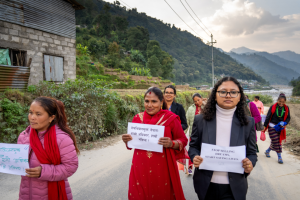
Like many women, during the Nepalese civil war, Shova’s husband was killed in conflict. As a widow, she faced discrimination, abuse and harassment for being a single woman – even from her in-laws. With support from our partner, Women for Human Rights (WHR), Shova joined a women-led group and now delivers educational training across districts to inform individuals of influence on the impact conflict has on women, and what can be done to support them. Shova has regained her voice, she is holding the government to account and is uniting conflict-affected women.
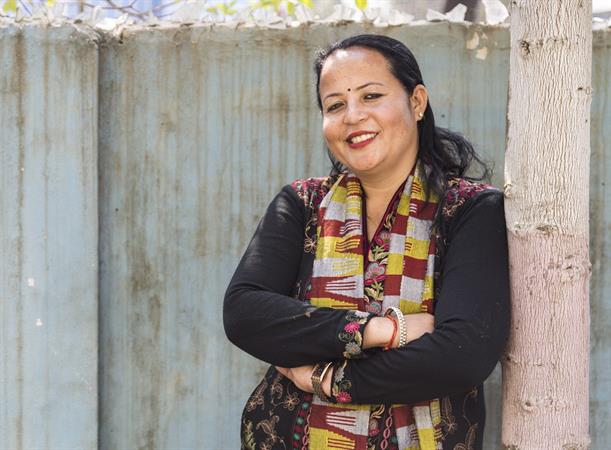
“My husband and I got married when I was 17. Four years later, he died in the army. He was shot, then covered in petrol and set alight so that no one could identify him. This is the story I was told; I will never know if that is the truth.
It happened during the night. I was at Teej festival (a festival in Nepal welcoming the monsoon season) with my 3-year-old daughter. I had spoken to my husband the day before. We heard about the fight the following morning and I received a call informing me of his death at 3pm. I fainted in the telephone booth. It was at that moment that I thought everything was over for me.
My husband was our main source of income, and after his death, we had no money so I had to stay at my mother’s house. My in-laws wouldn’t accept that he was dead and didn’t want to believe me. They tortured me, they said I was a ‘misfortune’, they blamed me for his death. After losing their husbands, women are expected to wear white dresses – no tika, no bangles, nothing. On the 45th day after his death, I decided to stop. It was a protest; I could not live my life if I had to live like that forever.
Once, I was travelling on a bus and a man asked me if I was married. I said yes, but he told me I didn’t ‘look married’. He molested me on the bus and he was abusive. When I opened my tailoring shop, he stalked me for a month so I reported him to the police. As a widow, I had a few incidents like this – there is a lot of discrimination against us.
I really wanted to be rescued from my life of fear and grief, so I was really relieved when WHR found me. WHR came searching for conflict-affected women to support. Originally, I thought they were from the Maoists (a political party in Nepal) and I thought they were going to kill me and my daughter. But I learnt they were there to help. I was so relieved to find someone who could support me to escape the discrimination. I feel like the WHR group was my rebirth, after my mum died, they was no one else there for me. The group has given me a new life.
Through WHR, I have received training on gender-based violence, domestic violence, human rights and women’s rights. They have helped us to become economically independent; before, my money used to be in my mother-in-law’s account so I couldn’t do anything without her permission. After joining WHR, I was able to access a small grant to expand my tailoring shop. Now, I employ a conflict-affected woman from the Maoist side and another from my community – we have won awards for our unity.
Since getting involved, I have learnt how both, Maoist and police families have been affected by the conflict. We’re now working together to help each other. I am playing the role of a leader to unite these women. Now, whenever I meet Maoist chiefs or leaders, I educate them and inform them of the impact the conflict has had on women.
Although my husband was in the army, my case was not recognised by the courts. They government didn’t identify me as conflict-affected because my husband had weapons to fight back. They didn’t think I was entitled to any support, so I now keep lobbying them for myself and other women.
As a leader I go to different districts and provide training for other conflict-affected women. I show them that we can unite. I have reunited with my in-laws too. Many women in rural areas are trapped; the government doesn’t notice them and their children aren’t going to school. I am worried there will be another conflict – we need to raise awareness of marginalised women affected.”
< View all stories