Leave no one behind: Has the Global Disability Summit delivered for women and girls with disabilities?
By Caroline Haworth
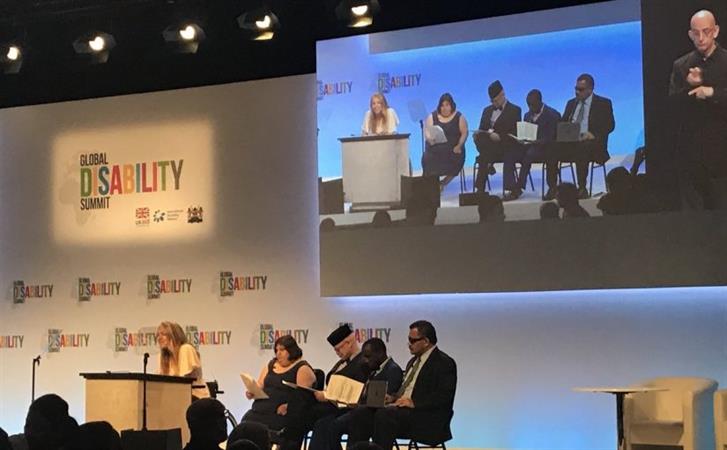
The first ever Global Disability Summit promised to be a turning point in moving disability up the global political agenda and ensuring that the voices of people living with disabilities were given central stage. The 2 day event represented a unique opportunity to shine a spotlight on the needs of the most marginalised and excluded populations with disabilities, including women and girls.
Around one in five women worldwide has a disability and two thirds of people with vision impairments are women. Women and girls with disabilities face the same spectrum of human rights violations that women without disabilities face, but they often face social stigma and multiple and intersecting discriminations on the basis of their gender and disability, as well as other factors such as age, race, ethnicity, sexual orientation, caste, and religion. Multiple discriminations against women and girls with disabilities affects every single aspect of their lives, including their ability to access education, vital health services, and employment opportunities, as well as participate meaningfully in decisions that concern and affect them. It also makes them at a higher risk of abuse and violence and of becoming infected with HIV.
This week’s Global Disability Summit aimed to galvanise the global effort on disability inclusion in the poorest countries in the world and be an important catalyst for change. The commitment to addressing gender inequality as a cross cutting theme meant that this could be a platform for women living with disabilities to be heard, for structural barriers that affect them to be better understood and recognised, and for disabled women’s rights organisations to raise their voice amidst the broader global civil society disability movement. But has the Summit delivered?
The Summit itself was significant for raising the issue of disability – and the UK government has to be congratulated for taking the lead in making it happen. It is also undeniable that the Summit generated useful discussions and gave an unprecedented platform to people living with disabilities to tell their stories. The Summit brought some much-needed attention to the key priorities identified by Womankind’s partner organisations led by and for women with disabilities – Nepal Disabled Women’s Association, Women Challenged to Challenge in Kenya, Ethiopia Women with Disability National Association, Deaf Women Included in Zimbabwe, and National Union of Women with Disabilities of Uganda – including violence, stigma and discrimination, lack of access to education and health services, exclusion from meaningful political participation and economic power, and lack of visibility and participation in data collection.
Where the Summit appeared to fall short was in its understanding of and engagement with issues of intersectionality and crucially how that shapes gender inequality – the notion that, in practice, multiple identities (including disability and gender) intersect, often resulting in women and girls with disabilities facing compounded and unique experiences of discrimination, marginalisation and oppression, which can change over time. Feminist activist Pratima Gurung of National Indigenous Disabled Women Association Nepal was one of the only people to address this head on. Illuminating how ‘intersectionality is about power’, she provided inspirational analysis on the need for us to reflect on why people with multiple intersecting identities were still not at the table. She called for greater recognition of the potential for diversity to be a great strength – with multiple identities and the intersections between them supporting connectivity within and between our various movements.