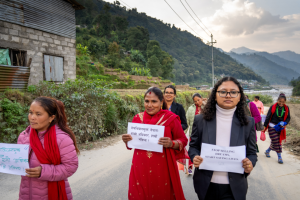
Amplifying the voices of the marginalised: how the PAVE project increased participation & leadership among women in Nepal
By Womankind Worldwide
Addressing intersecting forms of discrimination
For women across the world, the path to political office can often be a long and complex one. Gender bias towards male leadership is a common reality fuelled by discriminatory views that women are not as capable as men to lead, or that women should remain in the home. Then there’s the issue of resources: to be elected, candidates typically need substantial financial backing and time to network – things that women often lack because of the disproportionate amount of unpaid care work they traditionally take on.
These unjust realities are certainly true for women in Nepal, but for marginalised poor rural women the challenges are amplified as they’re subjected to different layers of discrimination. For example, rural women in Nepal don’t only face gender discrimination, they also face caste-based discrimination because they are Dalit, or discrimination based on their marital status if they are single women (widowed and/or unmarried), or discrimination if they have a disability. Some women face all these discriminating factors at the same time.
The Participation and Voice for Excluded Women in Nepal (PAVE) project implemented by our partners Feminist Dalit Organisation (FEDO), Women for Human Rights (WHR) and Tewa Women’s Fund has directly addressed the barriers to leadership for marginalised women in five districts of Province 7 in Nepal.
Unlocking women’s potential
In the past, women who were elected had limited or no support given to them on the job, making it extremely difficult for them to succeed. The PAVE project addressed this specific barrier. Working with 178 marginalised elected women, PAVE brought them tailored leadership training so that they can be effective in political office. The training helped women to understand local government procedures and systems, as well as develop advocacy and public speaking skills. With this knowledge, elected women have made real, tangible changes for their constituents, including releasing government funds for women with disabilities and ensuring women are represented in local school management committees. Elected women have also been given entrepreneurship training and business grants to make them more financially secure and independent. Some women have used these funds for their political campaigns in May 2022 – and many have been re-elected!
Ghanti BK from Accham district, who invested her grant in her business and used the savings for her campaign, says:
‘The project has supported me directly financially, but the indirect implication of the project is even more – women like me are slowly but steadily being an example for change, being financially independent, politically aware and socially active.’
The power of safe spaces to build women’s confidence
For women in rural communities in Nepal, coming together with other women in groups has been a lifeline. It has allowed them to consider a future beyond the home. FEDO, WHR and Tewa created women’s groups in the five districts and participants included Dalit women, single women and women with disabilities.
Gomati Bhandari, an unmarried woman with a physical disability from Kanchanpur district, joined a single women’s group. She says, “Participating in the discussion in the meeting, my confidence and knowledge was increasing. I am not literate but the Social Mobilizer explains in simple terms, so I started to understand.”
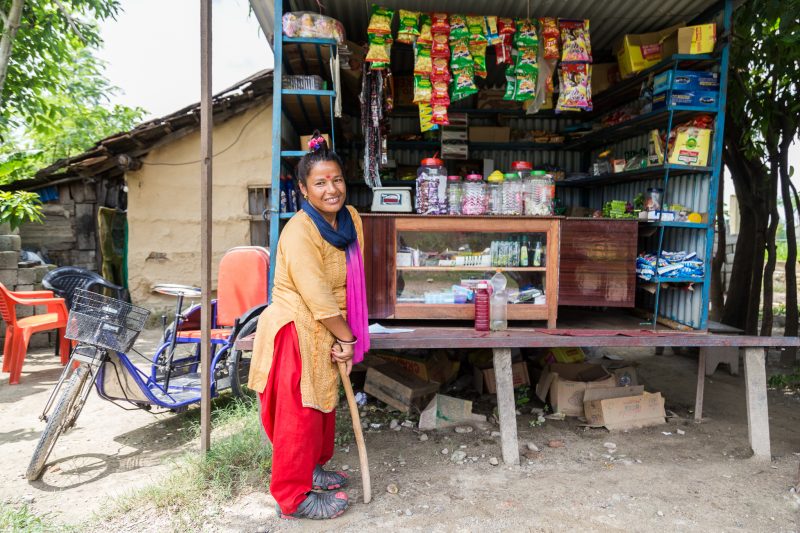
Crucially, the groups have also supported women to take collective action together, such as campaigning against violence against women and girls and advocating for citizenship rights for other women in their group.
Strengthening the women’s movement
Supporting individual women is only one way for woman’s rights to be achieved. Tewa, WHR and FEDO have worked closely together to make sure the project addresses multiple forms of discrimination, beyond gender. FEDO has enhanced the focus on Dalit rights in WHR and Tewa’s work, while WHR has helped bring the rights of single women to the forefront in Tewa and FEDO’s work. And Tewa has brought a disability inclusion focus to the project.
While the PAVE project has now been completed, its influence will have a long-lasting effect. For example, the project also established a Women’s Rights Platform in Province 7 with representation from women’s rights organisations across the province. This platform will act as a central place beyond the project from where women’s rights organisations can develop advocacy plans that meet the needs of the province’s most marginalised women.
Find out more about our learnings from the project in our paper and video here