
Afghan Women Demand Action: Insights from the GAPS Shadow Report
By Maryam Rahmani, Afghanistan Advisor
As we mark 25 years of the Women, Peace and Security (WPS) agenda, the GAPS 2024 Shadow Report reminds us that words without action are not enough. Through in-depth analysis and country-specific case studies, the report provides a timely civil society assessment of the UK Government’s implementation of its commitments as outlined in the WPS National Action Plan (NAP) for 2023–2027.
This year’s Shadow Report arrives at a fundamental moment: within increasing global militarisation, severe aid cuts, and a growing backlash against gender rights. Drawing from the lived experiences and expertise of women’s rights organisations and activists, the report offers urgent recommendations that challenge the UK to live up to its commitments. It underscores that meaningful peace cannot exist without gender equality — and that women’s leadership must be central in any crisis response.
The report includes detailed stories from five conflict-affected contexts: Afghanistan, Ukraine, Sudan, the Democratic Republic of the Congo (DRC), and the Occupied Palestinian Territory (OPT). These stories collectively expose the urgent need for consistent and meaningful WPS implementation. Each case study is grounded in local expertise and concludes with recommendations aimed at driving transformative change.
Afghanistan: Back to the Shadows
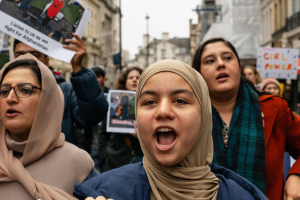
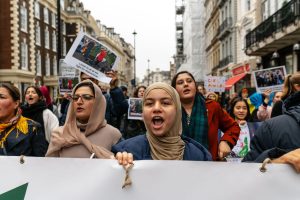
Among the case studies featured, Afghanistan stands as a powerful, painful example of how rapidly women’s rights can decline under authoritarian regimes. Following the Taliban’s return to power in 2021, Afghan women have faced escalating violence, repression, and exclusion from every sphere of public life. Women and girls are barred from education beyond primary school, denied the right to work in most sectors, and are subject to surveillance, forced marriages, and severe mobility restrictions.
Although these abuses are widespread, the international community — including the UK has found it difficult to provide a sufficient and steady response. The UK’s WPS NAP includes Afghanistan as a focus country, yet the report reveals that the commitments outlined have been inconsistently applied and often do not translate into meaningful action on the ground.
Womankind’s Contribution: Listening to Afghan Women
Womankind Worldwide contributed to the Afghanistan case study in this report. Developed in collaboration with Afghan women’s rights defenders and partner organisations in country, Womankind’s Advisor/Advocate on Afghanistan, Maryam Rahmani, lays out the gendered impact of the Taliban’s rule and key recommendations for the UK government, informed by Afghan women’s voices.
The case study highlights how the rollback of women’s rights is not only a humanitarian and human rights issue, but also a direct threat to peace and stability.
Key Recommendations for the UK Government
Womankind joins GAPs in calling for urgent and bold action from the UK. Key recommendations include:
- Implement and report on WPS commitments in Afghanistan
Deliver on the UK’s commitments to Afghanistan as a WPS focus country by resourcing a gender focal point, developing a gender strategy, and updating the government’s gender and inclusion analysis. Regularly monitor and report progress to Parliament and civil society.
- Increase support for Afghan women’s organisations
Provide long-term, flexible funding and technical support directly to Afghan women-led and women’s rights organisations so they can continue their vital work under difficult conditions.
- Support legal efforts on gender apartheid
Back legal and human rights efforts pushing for international recognition and accountability around ‘gender apartheid’.
- Ensure safe routes and gender-responsive asylum and resettlement
Make sure Afghan women, girls, and minorities have safe pathways to seek asylum in the UK. Fully implement Pathway 3 of the Afghan Citizens Resettlement Scheme with a gender-sensitive approach.
- Adopt principled, rights-based engagement with Afghanistan
Engage with Afghan civil society—especially women’s groups—when shaping UK policy on Afghanistan. This must not legitimise the Taliban but reflect local expertise. Align efforts with international partners.
- Ensure Afghan women’s participation
Guarantee meaningful involvement of Afghan women in all international discussions on Afghanistan, including future Doha talks. Include women inside Afghanistan, in exile, and in the diaspora. Use tools like Beyond Consultations to guide inclusive engagement.
- Develop a gender-responsive humanitarian response
Support a humanitarian plan that directly addresses Afghan women and girls’ needs, including access to food, healthcare and protection.
In a funding environment defined by extraordinary cuts to aid — particularly gender-focused aid — this report acts as both a warning and a blueprint. It shows what happens when WPS commitments are not backed by political will or resourcing: women are silenced, movements are dismantled, and the possibility of peace collapses.
By centring feminist analysis, the GAPS Shadow Report provides a roadmap for rights-based, gender-just approaches to conflict. It reflects what local activists and WROs already know: that peace cannot be parachuted in, and that without the voices of women, it will not last.
Final Thoughts
Reports like this are not just evaluations — they are calls to action. They document reality, elevate the demands of those most affected, and give decision-makers a chance to do better. In the case of Afghanistan, the silence of the international community is felt most painfully. Afghan women continue to resist, organise and care for their communities — often at great personal risk. The least we can do is listen, act, and hold our governments accountable.
Let this not be another missed opportunity.