
Gloria Mutyaba – a story of creativity and grounding in feminism
By Womankind Worldwide
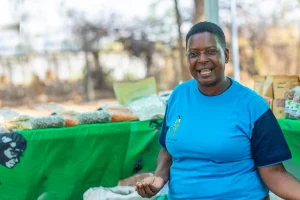
Gloria Mutyaba stands as a powerful advocate for intersectional feminist organising in Uganda. As Programmes Director of Freedom and Roam Uganda (FARUG), she takes pride in being “part of history and maintaining the legacy of an organisation that was founded in Uganda as the first and only LBQ organisation in the country.”
FARUG’s contribution has been transformative. “LBQ women are often left out of women’s rights and also LGBT spaces. Because of the space that we are holding for LBQ organising in Uganda and East Africa as a whole, I feel that we have maintained and grown how LBQ women are perceived and recognised within the feminist movement,” she says.
For Gloria, the most pressing threat to feminism is “how feminist movements have been co-opted and depoliticised. And how technology is making feminist language become more of a trend or a fashion.”
“It has its advantages and its disadvantages, because we see more widespread feminism within young people, which is now the biggest population in Africa, but it also scares me about how now feminism is being diluted, like something to make money off.”
This dilution has manifested through recent funding cuts. “As an LGBT community, I feel like we were affected the most by these funding cuts, especially in Uganda, because one of our biggest entry points in our organising had always been health. And health being one of our biggest entry points also meant that a lot of funding that was sustaining movement work and organising was coming from health.”
The impact has been devastating. “Mental health support, legal aid, emergency response – most of those things were being supported by that money. We had a drop-in centre, which was shut down, and it’s not only our drop-in centre that has been shut down, a number of drop-in centres have shut down,” she explains.
“It’s not even just about the building and the safe space. It’s safety for communities, it’s care for communities, it’s dignity. Because these were spaces which were safe and affirming for our communities and when such spaces do not exist anymore, the community is suffering.”
Some organisations have collapsed entirely, with “organisations whose entire funding was just coming from health-related programming. These organisations have actually collapsed on the ground because their entire existence was around health-related programming.”
The funding crisis has created impossible choices. “With the funding cuts in the U.S., part of the sections that were affected the most is sexual and reproductive health and rights (SRHR), and abortion. It’s very painful when you’re having conversations with some of your funders who are coming out and telling you, you know what? Either you let go of your work around abortion, or we cannot fund you anymore.”
“This threatens the very core or heart of feminism, which is about collective liberation. It’s not about branding, it’s not about charity, it’s not about complying with systems that oppress us.”
Despite challenges, FARUG continues adapting. “We also recognise that resilience does not have to be formal to be powerful. So, we are continuing to adapt by not just reacting, but also protecting our vision.”
Gloria sees a clear path forward. “We need to stay grounded in feminism itself, but also in movement accountability. At FARUG, for instance, we constantly return to the demands and needs of our community.”
She emphasises that “funding must come with trust. Because most of the funding we get comes with control. Feminist solidarity means resourcing feminist work in a way that honours feminists, local knowledge, that centres care, and that refuses to trade safety for visibility.”
In her call to courage, Gloria urges that “courage looks like consistency and consistency looks like supporting queer and feminist movements, even when it’s politically inconvenient or risky.”
“Speak up – don’t be silent. Your silence gives power to the oppressor. Use your voice to protect ours,” she says.
Gloria ends with a direct challenge: “Be intentional, go beyond statements and into solidarity. Don’t just recognise us. Resource us.”