
Patience Mandishona – a story of resilience with a touch of radical
By Womankind Worldwide
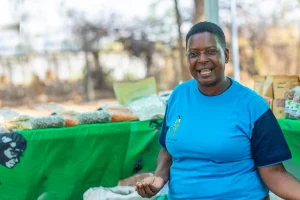
Patience Mandishona leads Pakasipiti, a feminist organisation carving out essential spaces for lesbian, bisexual, and queer (LBQ) women in Zimbabwe. Her organisation’s work spans advocacy, movement building, knowledge creation, and wellness, with growing focus on feminist young women’s leadership development.
“We are really anchored in being the voice of queer women within spaces where queer women might not necessarily be invited or be acknowledged,” Patience explains. “It’s about trying to be in that space and being the voice of diversity, of pushing for inclusion, of what intersectionality looks like when it comes to women’s rights and feminist organising.”
For Patience, the most pressing threat to feminism today is clear: “Right now, it’s the anti-gender and the anti-rights rhetoric and movement and the pushbacks that are coming with it towards women’s rights, LGBTQI+ rights and reproductive rights.”
The global nature of this threat has direct local implications. “You now have anti-LGBTI homophobic rhetoric coming from the US. What do the funding cuts mean for the black queer voice in that space? This trickles down even to our national level.”
Patience also sees the erosion of feminist language. “I see a space with this erasure of feminist human rights language, even within the UN platforms, UN documents,” she warns. “When we start negotiating to say, we cannot say rape, we have to say non-consensual sex, but it’s rape…when you start accepting the erasure of some language that gave us a political standing before, we’re actually losing the gains that we had.”
The global funding cuts have devastated Zimbabwe’s LBQ organising landscape. “One of the greatest impacts has obviously been the closure of some organisations,” Patience explains. The cuts particularly affected USAID-supported programmes, eliminating crucial employment opportunities and health service access.
“The communities are just being pushed underground and that has got a lot of implications in terms of their safety, in terms of their health, in terms of a lot of elements of their lives that depended on the spaces that were available.”
Community members in smaller towns face particular challenges. “You have more community members coming up saying OK, so if we can’t access our drop-in centres in our community, what does it mean? I’m in Mutare, I’m in a town that is outside Harare. But what about us that are in smaller towns?”
Zimbabwe’s February 2024 passage of the Private Voluntary Organisations (PVO) Bill has compounded these challenges, effectively preventing LBQ organisations from registering. Pakasipiti is considering alternative strategies: ” In terms of coming up with resource mobilisation strategies, who can we bring on board? How can we have conversations with some of our current donors about where else they see potential spaces for us to get funding support? Because there are donors who have pulled out and who might not definitely be funding us again.”
Despite these challenges, Pakasipiti continues to be a central support system for the LBQ community. But Patience shared that “one of our worries is organisations being shut down and closed. Right now it’s worrying because we do have a community to serve.”
In the face of the shrinking civic space and global funding cuts, Patience’s call to courage provides a transformative vision for moving forward. “We need resilience with a touch of radical. There is a need for us to take action and some kind of action that can be sustained.”
She emphasises that traditional solidarity approaches are insufficient. “Understanding struggles is not enough anymore. It’s really around taking action and taking that collective action. That sustained collective action is important.”
For Patience, the path forward requires both strategic adaptation and feminist resistance. “Sometimes taking those political positions and standpoints means saying we are not going to negotiate around this. This is how we’re going to express the issues that we’re talking about.”
Her call extends beyond Zimbabwe, to all who would support feminist and LBQ movements. “Solidarity must move beyond statements to sustained action, beyond understanding to concrete support, and beyond individual efforts to collective resistance that can weather anti-gender backlash while keeping essential spaces alive.”