
“Even now women are pushed way behind for being women”
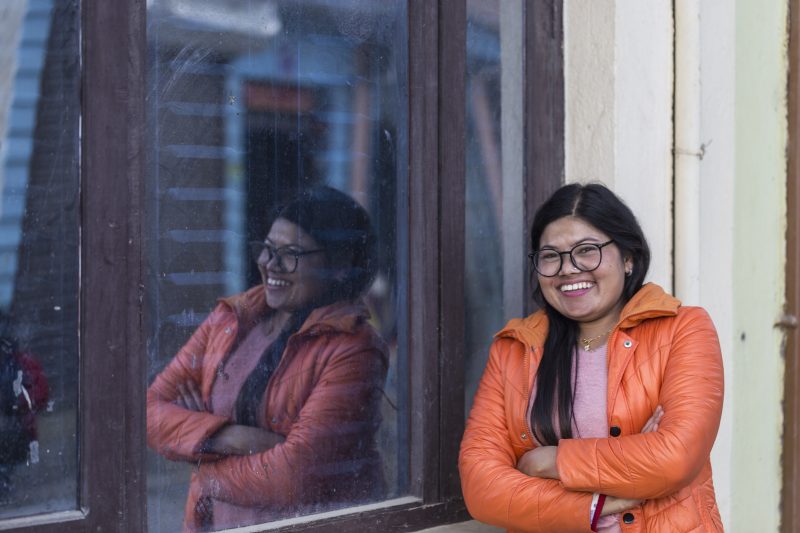
Pampha Purkoti is the General Secretary of Nepal Disabled Women’s Association’s (NDWA) Kavre chapter and has been leading the Access to Justice project there. She also works with Feminist Dalit Organisation (FEDO), NGO Federation Kavre and she is Vice President of Dalit With Disability Organisation Nepal.
Working with NDWA since 2017, Pampha draws on the intersections of her experience as a woman with a disability from the Dalit community and is seen as a pillar of support, trust and hope for women throughout Kavre.
Overcoming barriers to education
I was born into a very poor family even for the Dalit community. Born with disabilities, I have kyphosis in my back and my bones are not connected, so I have faced a lot of problems. In our community, once a daughter studies up to 4th or 5th grade, she’s married off or finds herself a love marriage with her studies coming to a stop. This is still the practice. With a context like this, it was assumed that because I am disabled, I would not marry, so the perspective was, if we get her to study then she might be able to work and feed herself.
My house is on top of the hill in my village. The school nearby only taught until tenth grade, so, I had to walk down for one to two hours to go to the school for eleventh grade. The class would begin from 6am in the morning so I had to travel alone. There was no one who had studied that much, not even the men in that village which had 80 Dalit households. In my family, my elder sister studied until 8th grade, my elder brother to 9th grade and my younger brother to 12th grade, but I did until Masters degree level.
After completing my final exams at the end of secondary school, I had to take a gap year because there was no money. After that, I told my elder brother that I wanted to study and that I should be enrolled at Tribhuvan University in Kathmandu to study journalism. When I arrived, I was told that I could study for free by showing my disability card. I was so happy knowing this that I bought the book on the same day and my studies began.
As a woman, a Dalit and having disabilities, getting an education makes it easier to work in or be acquainted with the community. But there are those who have not been to school. For them, it is difficult to rise above the double, triple discrimination and work or participate in society as others do.
Demanding access to rights and justice for women with disabilities
For us in a country like Nepal, even now women are pushed way behind for being women. If it is difficult for ‘able’ women to compete with men then for us with disabilities competing with them is unimaginable. On top of that, if you are a Dalit woman with a disability then there are so many years to wait to be equal.
Until now, women with disabilities have not known what needs to be done to access justice. They have not accepted themselves or that they have disabilities and they do not wish to be public at all. They cannot share their problems freely and it is poverty that is crushing them.
As general secretary of NDWA’s Kavre chapter, I look at the cases of women throughout the district and coordinate with the municipalities on any violence related cases. Alongside this, part of my role is pressuring municipalities for budget to be set aside for women with disabilities, and I have been advocating for their education, health and employment throughout the district. At NDWA, we are also doing activities with women with disabilities around budgeting focused in enhancing their skills.
There are many women who have been helped by NDWA. There were women who were scared to even talk about their problems but now their belief is that if they tell me, their heart will not only be lighter but also it will remain confidential. I have succeeded in gaining everyone’s trust, they can freely tell me things that happen in confidence and I do their counselling also. The difference in how they are now and how they were in the beginning makes me happy.

< View all stories