
“When you fund advocacy at all levels you’re going to have that permanent change, you’re going to have people that can hold others accountable.”
Jane is the Executive director of Polycom Development Project, an organisation that works on securing rights for young women and girls who live in informal settlements. Here she talks about the importance of advocacy and how Womankind’s Her Voice Fund is supporting a new generation of feminists.
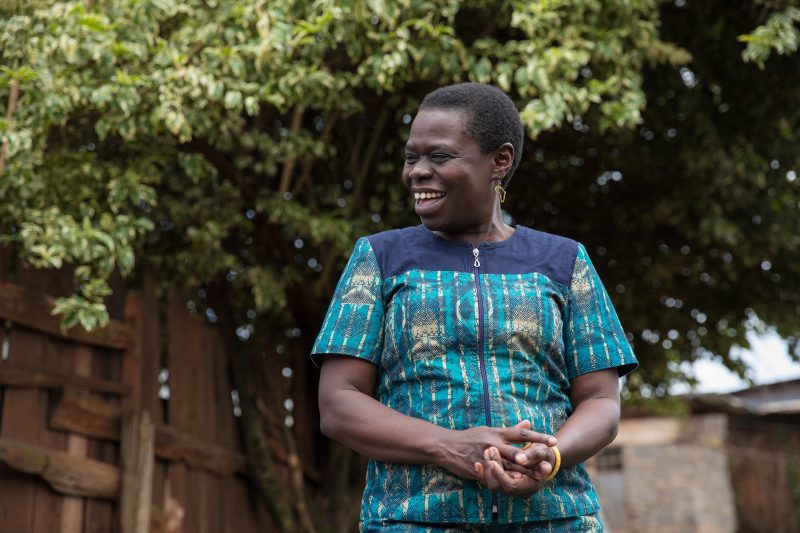
My name is Jane Anyango I live and work in Kibera [an informal settlement outside of Nairobi, Kenya]. Currently Polycom Development Project work is with women and girls, we are trying to work around issues affecting women living in the informal settlements and consolidate their voices and talk to policy makers on how to make sure that these women are safe.
Polycom is very lucky to have both community and global presence [at policy level]. Nationally, we developed the stakeholder’s assembly which gives an opportunity to hold meetings with different [government] departmental heads. We do this to ensure that every institution is working with women from the community. At the national level we participate in a lot of advocacy processes and we work with other women rights organisations in in our country.
Polycom represents the urban grassroots women, and we form more than 60 percent of women living in the informal settlement in Kenya so this is a mass that you cannot ignore. [Policy makers] engage with us because we add a lot of value. We have been able to attend regional and international meetings and so we’ve been able to influence or advocate for policy at a global scale.
To me advocacy is identifying an issue of importance to you and mobilising people to understand it and either support or condemn it. You can only stand for something that you understand.
From international to local: mobilising young feminists for change
Being able to participate in the Beijing+ 25 process meant so much to us. Being part of a process where we were able to voice our issues [in an international forum] and also compare policies with what we are already doing in the community meant so much for us. It gave us a lot of energy to be able to soldier on and speak about changes we want to see.
When we received funding to participate in the Beijing+25 process I thought that it was a great opportunity to amplify the voices of the young women who are doing so much yet not really recognised. I’m so proud that for the first time we were able to take six young women – the B+25 queens – who had never boarded a plane to Ethiopia for the Beijing+25 regional reviews. It was really powerful, and it made them understand what is possible. We can get into this space and effect change!
On the first day we were able to participate in a youth meeting. It was powerful for us and added a lot of value to us.
We all agreed that we had to make ourselves known in every meeting that we attended. So in every meeting even though we were not the official speakers we made sure that whenever we had an opportunity to speak we did. We spoke about where we are right now and about the progress that we want to make and how we make sure we leave no one behind.
We told everyone that even though this is the first time we are in a space like this that it won’t be the last time. We are occupying our space!
The B+25 Queens were able to make a lot of connections at the regional reviews and everyone was talking about Polycom. The young women are now a part of the young feminist movements who are doing a lot of work on women and girls rights and are learning from each other. Some of them are already working on vying for political positions.
The young women are also working to change the language around sexual health in the community which is changing minds. They are contributing to a lot of conversations online and they are able to go to various meetings. They’ve also been able to develop further through online trainings. There have been a lot of changes in the lives of these girls. They are no longer seeing themselves as girls in the community just volunteering, they are now seeing themselves as people who are learning to be better people and can make something out of their lives. They are learning that the power they have within is not just their power, it’s useless if they don’t use it to mobilise and share with others and lead others towards issues that affect them in the community.
Intersectional organising
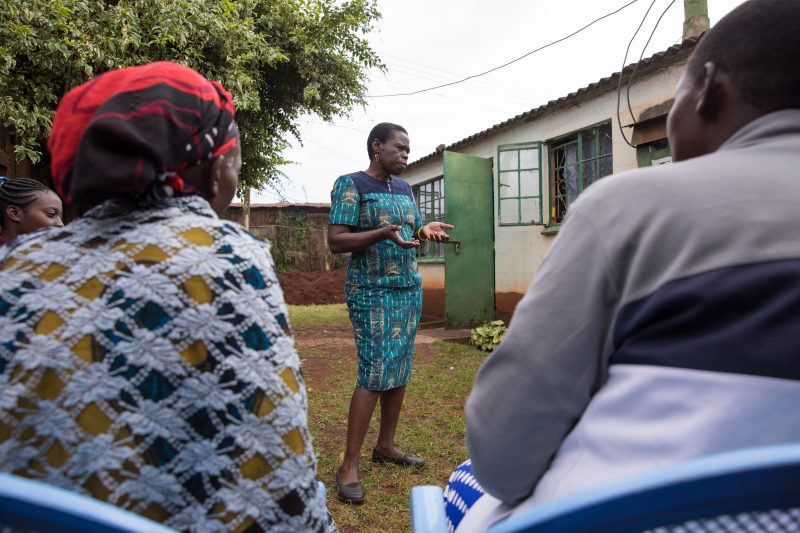
As well as advocacy work internationally, we work to advocate for the rights of women in the community. We have lobbied strongly for women with disabilities living in the informal settlements. We used 16 Days of Activism to talk a lot about the multiple discrimination that these women face. We were talking about disability cards which most people in the informal settlements don’t know about.
The disability card allows them to access services, for example they don’t have to queue for public transportation and they can request to be dropped at a more convenient place than the designated bus stop. The card also useful in being able to lobby for the government to give us special consideration, during COVID-19 we were able to secure more emergency supplies for women with disabilities in Kibera.
Because of Her Voice Fund we were able to use 16 days of activism to lobby very strongly for women with disabilities and even get the policy makers to factor them in their planning.
Shifting the narrative on sexual harassment
We’ve also been doing some advocacy on sexual harassment in informal settlements. We reached out to Womankind for support in collecting data on the types of harassment girls and young women face.
In Kenya we talk a lot about rape but we rarely look at the other forms of sexual harassment, like the [non-consensual] touching, the commenting [catcalling]. We were able to come up with this graphical representation of different forms of sexual harassment and then use that to have conversations with young women about their experiences of sexual harassment.
This is significant because a few years back a member of parliament came up with a bill to have stricter sentencing for perpetrators of sexual harassment but it was shot down, partly due to a lack of evidence.
Currently in Kenya sexual harassment is only defined as being able to happen within formal institutions like employment and things. So being able to engage girls in the community shows that it can happen anywhere and anytime. We showed that it is the red flag towards rape, it isn’t something that just happens – it starts small, first they look at you then when nothing happens to them they start commenting, then when nothing is done about it they continue to advance [to more extreme sexual violence]. Addressing sexual harassment is a great way of fighting sexual violence. [due to the advocacy of Polycom, sexual harassment of girls in Kibera has made national news and MPs have made commitments to supporting the sexual offences bill.]
Funding advocacy, accelerating rights
Funding advocacy is very important for women’s rights because it’s about sustaining the momentum [of women’s rights organisations]. When you fund advocacy at all levels you’re going to have that permanent change, you’re going to have people that can hold others accountable. If it is not funded people cannot hold decision makers to account.
< View all stories