Dinah Musindarwezo- the activist and mobiliser
By Womankind Worldwide
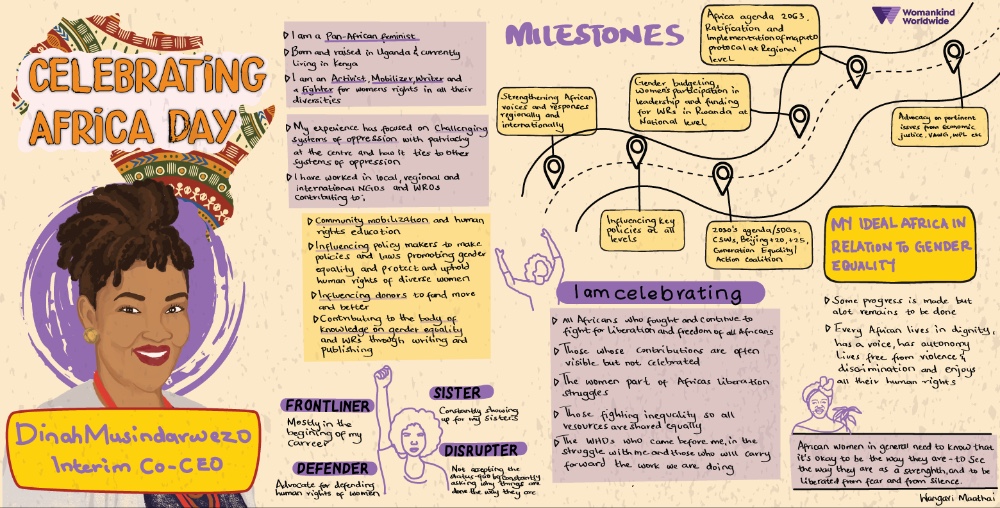
Dinah is a Rwandan pan-African feminist born and raised in Uganda and currently the Interim Co-CEO in Womankind. As an activist and mobiliser, she’s been at the helm of championing women’s rights by challenging systems of oppression such as patriarchy, capitalism and white supremacy. Her working experience spans to working with national, regional and international NGOs and women’s rights organisations where she’s led human rights education, policy influencing and challenging the donor community to fund community, national and regional based women’s rights organisations. She’s also influenced thought-leadership in the feminism movement by publishing academic pieces on various topics such as feminist organising, gender justice and women’s rights.
Where would you cluster yourself in the feminist space? Are you an igniter, disrupter, defender, front-liner or sister?
I have exuded all these dynamics across various aspects of my journey. When I began activism work, I was a frontliner, defending women’s rights. I am constantly disrupting the status quo in the feminism movements by questioning why things are done the same way. As a sister I stand in solidarity with my fellow sisters in the struggle while also introspecting how I show up as a sister.
Would you share with us some of your milestones and contributions in the feminism movement?
My contributions to the movement have been alongside credible feminist voices in the space who taught me the power of collective action. I’ve been at the helm of strengthening the African feminist movement since my time at FEMNET and in the African policy spaces to ensure the voices of African women are heard and included. Influencing policies at the local, regional and global levels as part of the African feminist organizing has also been a critical component of my journey particularly in forums such as CSW, Generation Equality, Beijing +20 & 25, Financing for Development, and Africa Agenda 2063.
I am passionate about economic justice issues such as debt, trade, unpaid care work and domestic work, and advocating for women’s labour rights as they’re quite instrumental in addressing women’s economic rights. At Womankind I’ve also been keen on championing decolonization and anti-racism disrupting our way of thinking and doing aligning with our mission to advance the human rights of all diverse women and girls.
What are you celebrating on this Africa Day? OR Who are you celebrating on this Africa Day?
I celebrate all Africans who have fought and those continuing to fight for liberation and freedoms of Africans in all their diversities. I especially celebrate those whose contributions are often invisible but still not celebrated- the Sheroes and Heroes who never made it to history books or the media. I am reminded of women who were part of Africa’s liberation struggles, human rights defenders fighting modern slavery, those pushing for liberation of those most marginalised and all those fighting inequalities between countries and people so that all resources are shared equally.
I also celebrate the women human rights defenders who came before me, those still in the struggle and those who will carry forward the work we are currently doing.
What would you like to reiterate in this year’s Africa day in relation to gender equality? And what’s your ideal Africa when it comes to realizing gender equality
Some progress has been made in pushing for gender equality, but we still have a long way to make this a realisation for all African women and girls.
My ideal Africa is one where every African lives in dignity, has voice and autonomy over their lives, lives free from violence and discrimination and enjoys their human rights.
Any special quote from feminist sisters or feminist respected leaders that you’d like to highlight on this Africa Day?
Wangari Maathai: ‘’African women in general need to know that it’s okay to be the way they are- to see the way they as a strength, and to be liberated from fear and from silence.’’
This quote reminds me that as an African black woman I am enough in my existence and power, and it is my hope that it will remind my other African sisters who maybe meant to feel that they are not enough.