Girls will run the world: Supporting young women to realise their rights
By Louise Hemfrey

For over 30 years Womankind Worldwide has worked to advance the rights of women and girls. What we have learnt from this work, is that young women and girls, those under 30 years of age, are impacted by all of the issues that adult women are impacted by, but that these issues are often compounded by their position as youth. For example UNICEF estimates 1 in 10 girls will experience some form of sexual violence before they reach adulthood, while as many as 700 million adult women around the world were married before age 18.
Young women and girls consequently have fewer opportunities to exercise agency in their lives, and less power over the decisions that affect them most. Something which has been recognised by the creation of the generation equality forums bringing together women and girls of different ages.
Collective consciousness for young women in Nepal

We deliberately work with organisations and groups who address the imbalance in young women’s power. One of our most recent projects with LOOM in Nepal works to harnesses the collective power of women through multi-generational activism.
In Nepal, as in many countries, age can determine opportunities to lead, speak out and have your opinions respected. LOOM works with community-based women’s groups, building space for activists across different generations to share, connect, organise and transform structures that obstruct women’s rights. Through workshops and feminist storytelling women of all ages build connections on commonalities and learn from each other’s different experiences.
For the women who engage in these multi-generational spaces, different types of activism have blossomed. For young women, like Manju Karki, 20, speaking to other feminist activists motivated her to setup and chair a young women’s collective in her community: “I think I am more confident and have a positive attitude than before. I also realised that I can inspire many women like me to resolve their problems, and if I worked hard, then I can achieve a lot and bring positive change in my life.”
Established community organisation leaders, like Sunita Sah, have been able to diversify their campaigns: “I had only focused on violence. I had no idea that sexuality and leadership also exists, and I feel free and eager to continue my work. The participants who have attended the interaction program has given feedback that these kind of interactions has brought a lot of changes in the women of community.”
The sharing of ideas and the recognition of all experiences across generations is crucial in creating a stronger more inclusive women’s movement that can contribute to the future of Nepal.
Convening the next generation in Kenya
Through a similar ground breaking approach, Womankind’s work with young women in Kenya focused on a Young Feminists Convening in 2018. This was developed in response to young women’s experience of exclusion in the Kenyan women’s movement and their desire to create a safe space to strategise on key issues affecting young women and girls.
Womankind worked with a committee of 10 young women from different thematic sectors, ethnicities, locations and sexualities, to lead the convening. In doing so, the convening truly reflected the needs and challenges that young women expressed but also began the process of solving them, with collective power and expertise. Four subsequent regional events designed by the attendees to the first convening, have produced concrete connections between activists as well as an acknowledgement of the need to bring more diversity into the women’s movement.
Diversifying the conversation in Uganda
Most recently, Womankind has been collaborating with six partners in Uganda, on a 12 month pilot project on Women’s Advocacy for Voice and Empowerment (WAVE). Their main focus has been to build a more inclusive intersectional women’s movement. To do this they brought together activists from the disability, LBTQI+ and young women’s communities with mainstream women’s rights organisations. One of the six partners, Mentoring and Empowerment Programme for Young Women (MEMPROW) spearheaded the provision of spaces for young women and girls to challenge gender inequalities and, learn about feminism from older, established professionals in the Ugandan women’s movement.
From their work, MEMPROW have seen a change in mind-set and attitudes from participants who did not identify as feminist, did not know about feminism and those that discriminated against people of different gender and sexual orientations. Participants, such as Patience Arinaitwe, who works in a community support centre, acknowledged: “This 3 days training on feminism has been actually an eye opener to what I thought was bad especially on sexual orientation and gender identity. Through the training, I have been able to discover a lot of things about them.” Very soon Womankind will be publishing our next Learning Paper on the WAVE project, which will expand further on the importance of an intersectional feminist women’s movement in Uganda.
Girls changing norms in Ethiopia
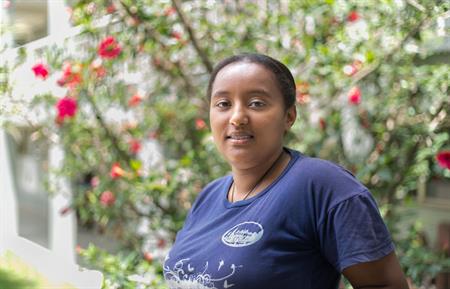
With partner Setaweet, Womankind has also been working with young people to create change in Ethiopia through Gendershops. Through these workshops, students were given the space to identify and challenge issues like sexual harassment, toxic masculinity and consent. Crucial training in teaching young people about girls rights to live free from harassment.
Girls’ voices in COVID-19 response
Throughout our history and our partnerships, we know that women’s movements are a force for change. As the impacts of Covid-19 continue to reverberate globally, we know it is more important than ever that women’s voices and women’s leadership are integrated into response and recovery.
Young women and girls are just as affected by the impacts of the virus, and are already innovating ways to support each other, and their local communities. Our partner, Polycom Development Project (Polycom), have been adapting their work and provide new ways to support school-age girls in Kibera informal settlement, in Nairobi. Polycom pioneered the use of ‘talking boxes’ in schools, as a method for girls to report sexual harassment and abuse anonymously, without fear of stigmatisation. With schools closed since 23rd March in Kenya, to retain access to this crucial reporting mechanism for girls, Polycom have setup talking boxes in administrative centres where people collect food aid and have conducted socially distanced feedback sessions with peer mentors to make sure girls are still getting access to this service.
What next?
All of the partners and projects mentioned here, are working towards the same goal: universal women’s rights. They know this will only be realised when women across movements and borders, abilities, races, young and old, cisgender and LBTQI, can recognise the struggle they share.
Read more about the strength of inclusive women’s movements in our learning papers series.