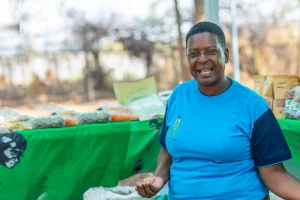
“I think women coming together is the best thing so women can be more powerful”
Elizabeth, aged 40, was forcefully evicted from her home in 2014. Elizabeth now lives with her husband and children in the displacement camp, where she advocates passionately for women on the radio with the support of Womankind partner, National Association for Professional Environmentalists (NAPE).

“I was lucky – I got to go to school until I was 17. I got married at 19 years old. Life was okay; we were not suffering. We cultivated land, so we made money to look after our six children.
I had heard a rumour that something was going to happen. On that fateful day, I was in the garden and my husband came running. We ran to the house to get the children. There was so much violence closing in on us. We wanted to grab a few of our belongings but we didn’t have time, my husband was taken away. I went back later to see if I could rescue anything, but our house was burning to the ground. We were affected by tear gas – afterwards I experienced severe headaches and my skin was itching from the inside. My children all had headaches and said they felt pain in their eyes and face.
One neighbour had a child who got tear gassed during the eviction. He died three days later. A mother with her six-year-old were knocked down by a vehicle and the child was killed and the woman injured. Another child was running and his legs were burnt. I have never once felt okay since we were evicted.
When my husband returned, he found us in the displacement camp. The situation was terrible. We had to quickly build our own home so we could sleep in safety. We can’t even afford bed sheets. My children are always falling sick because of the cold and malaria, but we have no money to take them for medical treatment. One of my children had to go to relatives as he was so sick at the camp. I miss him every day but I hope he has a better life there.
I have three children at school but we don’t have money for their next school fees. We don’t have proper schools. Because of the camp situation, my daughter got married before completing her education. On the long distances we have to send our children to school now, the sugarcane workers shout at them and harass them. Even the older children are scared.
It’s been three years, and some people still have nowhere to sleep. We have no health centres for treatment nearby. One centre is very far but even if we go there, we have no money to pay to treat our children. We have dirty water, even when we walk far to get it.
What disturbs me the most is that it is the women in the camp who have to go out and earn money to feed our families. The men do nothing. We women have to do everything. The sugarcane labourers touch us and chase us; we now run away from them whenever we see them. Violence happens in the camp too. Men keep beating their wives. I am lucky; I have a good husband. He understands our situation and together we are strong.
NAPE has brought us relief and hope. They gave us clothing, helped us with our court case and gave us financial support and advice. They also set up Community Green Radio, where our voices are recorded and put on the radio so our problems are listened to. I mobilise the Listeners Club to listen as well. I never miss it. When we have an issue, I call the women and we talk about it and then it goes on the radio so more women can come together. For example, I talked about violence against women and girls and how women can get support.
The radio has helped us as women to deal with issues. I think women coming together is the best thing so we can help with issues and women can be more powerful in our community. Men weren’t listening to us before, but now as we speak as one voice we are more respected. Now, men understand that women have rights.
It has been three years and we are still waiting for the court case so we can get the compensation we deserve. I hope that the future will be better. I am confident that if we work together, we will get the compensation we need to end our suffering and start new lives.”
*Name changed to protect identity
< View all stories