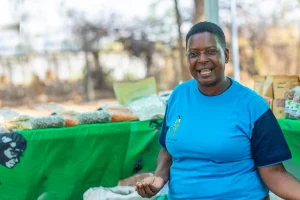
Feminist partnership in action
By Sierra Schraff Thomas and Anne Agar

Working in partnership is a key part of Our Feminist Future, Womankind’s strategy to 2030 and to our movement strengthening approach. As part of our strategy, Womankind updated our partnership principles, which underpin and define how Womankind engages with others.
So what does feminist partnership look like in action? And how is it different from other kinds of partnership? Womankind’s Sierra Schraff Thomas spoke to Polycom Girls Managing Director Anne Agar about just that.
Valuing the totality of our experiences
Feminist partnership is about “being able to show up as your full and authentic self”, says Anne. “Having spaces where you feel safe and free to communicate.”
Polycom Girls are often seen as ‘young mobilisers’ and might be asked to participate in certain spaces because they can convene a lot of young women, without their broader contribution always being considered. This can create a lot of pressure to represent the communities they work with. According to Anne, an important aspect of feminist partnership is about “knowing that your perspective is heard and respected based on the totality of your lived experience, knowledge of the context you work in and the communities you work with”.
“Everyone is a human being outside of their job and we all bring different experiences to our work”, says Anne. Centring wellbeing – both at Womankind and within our partnership – helps ensure that people can bring their whole self the work and to the partnership. This can take many forms, from funding self and collective care initiatives to the way we communicate amongst ourselves and with our partners.
Feminist power analysis

Another critical part of feminist partnership is power analysis: recognising and deconstructing the power dynamics between Womankind and partners, but also within feminist movements in a given context, or within organisations themselves. “It’s important to have awareness that in all spaces there are power dynamics and power relations that you have to navigate”, says Anne.
While social and cultural conventions are important, Anne feels that young people must also challenge systems of power. “It’s something we as an organisation or even me as a person have struggled with – that constant feeling that you need to shrink yourself to fit a certain narrative”.
When it comes to funders, these dynamics can be especially tricky to navigate due to the level of competition. “You might put up with something you don’t like, or bend over backward to fulfil a donor request, even if it’s not reasonable or strategic” says Anne. Working in feminist partnership with Womankind and knowing that funding was not contingent on leaping to fulfil certain requests has helped Polycom set clearer boundaries with other funders.
Sharing resources
Across our partnerships, it’s important for Womankind to acknowledge our historical and current positionality as a funder based in the global north – and actively seek to shift and share power with our partners and the broader feminist movement. We do this by sharing resources, for example through our flexible funding streams: the Her Voice Fund, the Movement Strengthening Fund and our recently launched Strategic Partner Support Grants.
Womankind also bridges between our partners and other resources, decision-makers, and political spaces that we may have access to that are relevant to their work and realities. “Sharing resources is so important”, says Anne. It might be funding but it could equally be a policy, an opportunity, or access to a network. “It’s actually these other types of support that I find even more valuable than the money”.
Polycom particularly appreciates the visibility Womankind gives to partner’s work and achievements. For some donors, it’s all about their own visibility. “You can have an event with 50 logos on a banner and no messaging”, says Anne. “That visibility becomes more important than ‘did this life actually change?’ ‘Did we achieve something?’”.
Womankind aims to leverage our communications and advocacy by amplifying the voices of our partners and the work they do. This could be by simply reposting their content or centring their expertise and demands in international advocacy fora or with the UK Government.

Constructive feedback and mutual learning
Being able to give and receive respectful and constructive feedback and to learn from each other is key to Womankind’s feminist partnership approach.
Some donors might say “we think you could do x activity that fits within our strategy, or they might just outright tell you ‘what you are doing does not work’”, says Anne. “This can be really demoralising!”.
With Womankind, there is more of a back-and-forth. Womankind staff might review a funding proposal and make suggestions about different ways to present a project. “You give feedback that actually helps – that makes the proposal better. It’s honest feedback, but it’s also constructive and supportive. That’s really special because it motivates us to keep trying.”
It’s important for Womankind that feedback is mutual and that processes such as the development of our strategy are co-creative. This helps ensure that our work is responsive, but is also a learning and exchange opportunities between ourselves and partners and among partners. “Everyone knows something or has experience they bring to the table” says Anne. “Being part of the process allows you to see how they might work for your institution as well. It’s not just taking information from you.”
One area that Womankind is working to strengthen is closing the feedback loop. Alongside the launch of the new partnership principles, one of our aims is to improve our communication to partners about how their feedback is used and what we are doing in response. Even when we aren’t able to do something, partners should always know they’ve been heard and that we really value everything they choose to share with us. This is essential to developing trust and further strengthening our partnerships.
Sisterhood
“For me what stands out about our partnership with Womankind is that we don’t have to adjust our story in any way. We can just speak the truth and that’s accepted. Our partnership has grown – in terms of resources but also in terms of openness and learning”, says Anne.
Building long-term relationships that grow and evolve over time is an essential part of Womankind’s approach to partnership. These relationships of sisterhood sustain and strength the feminist movements through which we are realising our feminist future.
Read more about Womankind’s approach to partnership and our recently updated feminist partnership principles here: https://www.womankind.org.uk/feminist-partnership/