Land is everything: women, climate crisis and extractivism in Uganda
By Hannah Coombes

Last month, the UN hosted the 66th edition of CSW, a major annual event in the feminist calendar where leaders, policy makers and campaigners come together to discuss women’s rights and gender equality (more on that here).
The main theme was “gender equality in the context of climate change, environmental and disaster risk reduction policies and programmes.” A theme that directly relates to our work in Uganda with our partners NAPE and NAWAD. Together we hosted an event that examined how climate change and land rights impact the lives of women in Uganda and across the Global South, focusing on the POWER project. Co-led by NAPE, NAWAD and Womankind Worldwide, this project strengthened the ecofeminist movement across 4 districts in Uganda by actively promoting and protecting women’s land rights, land ownership and livelihoods, and facilitating access to justice for policy change.
So, how do the climate crisis, extractivism and women’s rights intersect? What are the issues and what are the solutions? Here are some answers, informed by the rich knowledge shared during the event, by women at the forefront of their movements.
What is extractivism and what is happening in Uganda?
Extractivism is the removal of natural resources from the Earth for sale and profit – a practice that is on the rise in Uganda.
The country’s natural resources include oil, gas and sugarcane – and powerful companies are seizing them for extraction, supported by the Ugandan government who see it as a primary road to development, despite damaging the ecosystem, the environment and Ugandan livelihoods. Extractivism means that Ugandan women are forcibly evicted and displaced from the land that they rely upon to work and live, without proper compensation – causing mass displacement and poverty.
Why extractivism is a women’s rights issue
In Uganda, men are treated as landowners and women as land-users. Although women do the majority of agricultural labour – making up 76% of the Ugandan agricultural workforce – control of land is usually held by men. This, as highlighted by Sostine Namanya from the National Association of Professional Environmentalists (NAPE), is rooted in patriarchal structures that give men greater power over land and property, but also over women in their families. “When land is being taken away, women are losing the means to put food on the table” she says.
Due to land grabs, an estimated 400,000 marginalised women in the districts of Amuru, Nwoya, Hoima and Bulisa have been displaced or are at risk of displacement. Women are also often subjected to sexual harassment and sexual violence as a result of the extractivism model.
“Women’s livelihoods are destroyed by the extractive industries. When land compensation is paid, it goes to the recognised head of the household, which is typically the man” – Sostine Namanya
Joan Tumusiime is a grassroots women’s advocate supported by NAPE. As one of the women affected by an oil pipeline constructed in 2012 for extraction, she says the environmental degradation it led to is putting women at risk: a prolonged drought means women and children are forced to walk very long distances for water, and rates of violence against women and girls have increased.
“We need land rights protected. We need environmental protection, and we need our voices as women to be heard.” – Joan Tumusiime, Grassroots Women’s Advocate
Climate justice, women’s rights, land rights – we need feminist solutions
Extractivism is both a climate justice issue and a women’s rights issue with extractive industries devastating nature, the environment, women’s lives and livelihoods. It is impossible to ignore how patriarchy and capitalism cause and continue to exacerbate the climate crisis. This is why we need feminist solutions and women’s rights movements are playing a key role in helping to find them.
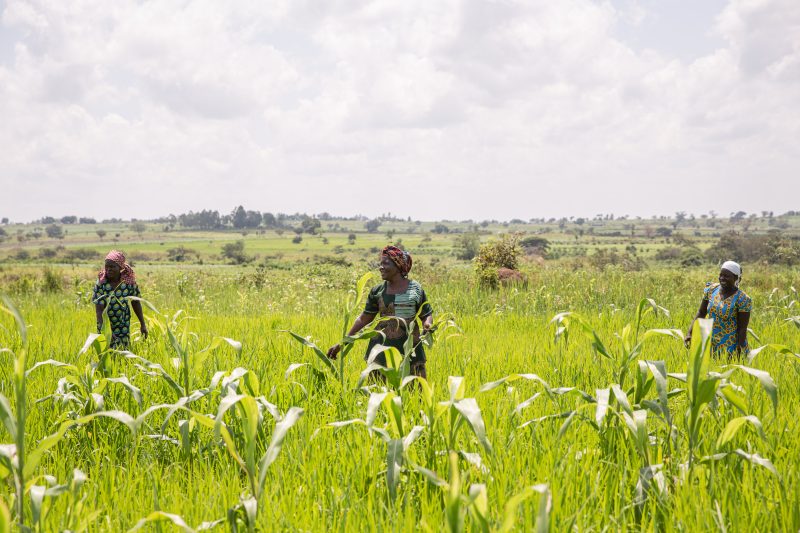
Womankind partners NAPE and NAWAD have been at the forefront of building a women-led eco-feminist movement in Uganda. For example, NAWAD has mobilised over 2000 rural women to influence decision-making processes for sustainable development and adoption of feminist livelihoods in communities affected by forceful land evictions. They continue to strengthen the eco-feminist movement in Northern Uganda by building solidarity among women, supporting them to challenge socio-economic and environmental injustices.
Sostine Namanya (NAPE) believes that the available alternatives already exist within the way that women take care of the environment, and made the following recommendations during CSW for the international community and policy makers:
- build alternative economies that are based on community, not on individuals.
- create sustainable indigenous ways for food production
- make policies that can expand women’s rights advocacy
- support women to know their rights
“As the POWER project has shown us, if women are aware of the entitlements in the Constitution, they are able to demand by referring to those legal instruments.” – Sostine Namanya
Joanne Tumusiime (Grassroots Women’s Advocate) says women must be supported to know their land rights and about alternative sources of energy while Junita Rai (National Indigenous Women’s Federation, Nepal) highlights the need to include Indigenous women in meaningful participation in climate talks: “Local voices HAVE to be incorporated.”
“The climate crisis is a system of patriarchy & oppression. And I think the role of women’s movements, intersecting maybe with other movements, is really to break that capitalistic system, to break that system of oppression and patriarchy.” Susann Scherbarth, Friends of the Earth Germany
Want to learn more? Watch the full webinar and/or read about the work of our partners NAPE and NAWAD in the links below.
Land is everything – Women, climate crisis and extractivism in Uganda – event recording
Reimagining the Future Beyond Extractives – A paper with and for the Ecofeminist movement in Uganda to outline potential for transformative change by NAPE and NAWAD
Unlocking Women’s Power in Uganda – a video about the POWER project